Tinda
Praecitrullus fistulosus · Also known as Tinda, Round gourd, Indian round gourd, Tindora (regional), Kundru (regional)
Tinda is a small, round, pale-green vegetable with tender skin and mild, slightly sweet flesh - a summer favourite in Indian home kitchens. Also called round gourd, it is eaten whole or halved, often pan-fried with onions and spices, stuffed with besan and herbs, or simmered in l...
Nutrition per 100 g
Mean values ± IFCT published SD (edible portion).
More macros
Classification
About Tinda
What it is
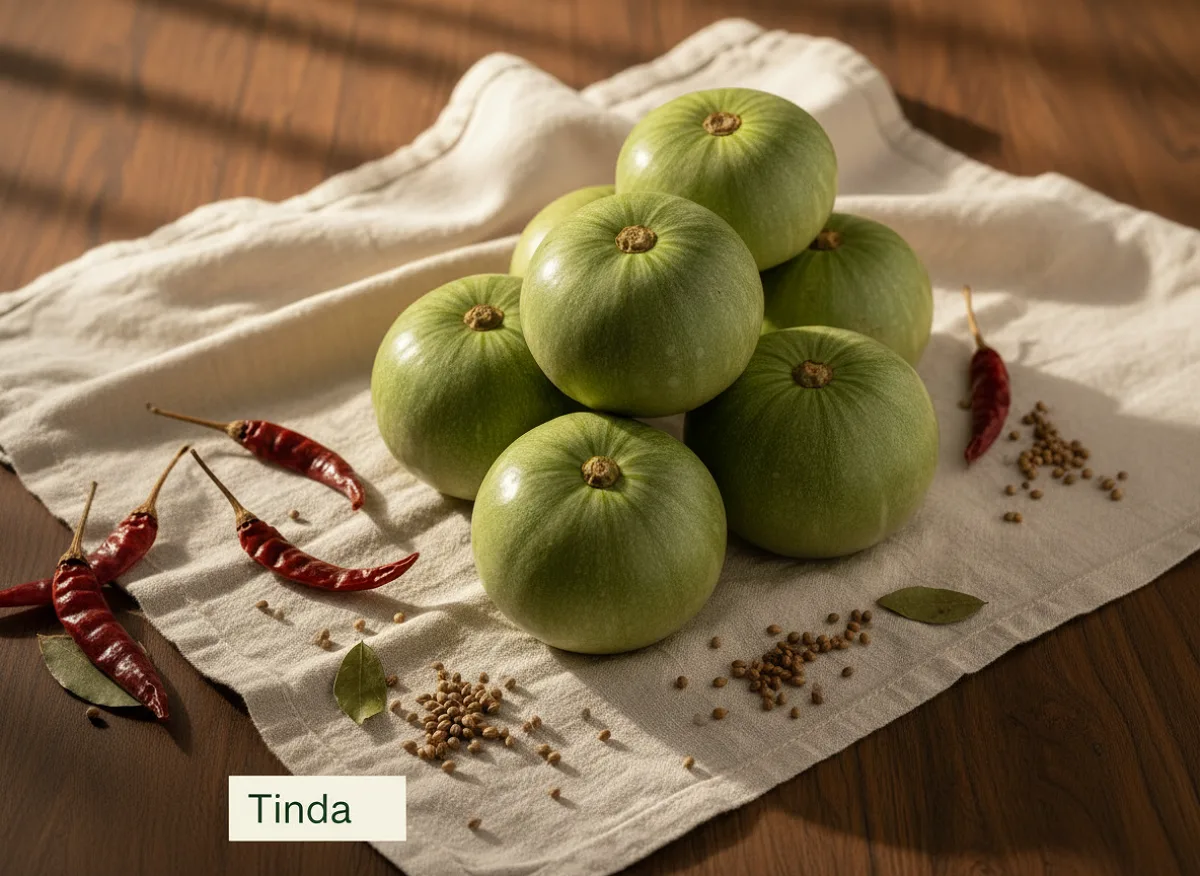
Tinda is a small, round summer squash with pale green to cream-coloured skin and tender, ivory flesh inside. Each fruit is typically the size of a small apple or tennis ball, with a thin, edible skin and very few seeds. It is eaten fresh and whole or halved, and is prized for its mild, slightly sweet flavour and soft texture when cooked. Tinda is a seasonal vegetable, most abundant during the monsoon and early autumn in North and Central India. (IFCT 2017, Ref #D073)
Use in Indian Kitchen
Tinda is a versatile summer vegetable in home cooking. It is commonly pan-fried whole or halved with onions, green chilli, and a tadka of cumin and mustard seeds - a simple, everyday sabzi. In North India, tinda is often stuffed with a spiced besan and onion filling, then shallow-fried until golden. It also appears in light curries, sometimes paired with tomato and coriander, or cooked with moong dal for a gentle, nourishing khichdi. A practical tip: tinda cooks quickly, so add it near the end of cooking to keep it tender and not mushy. Its mild flavour pairs well with tamarind, amchur, or a squeeze of lemon.
Key Nutrients
Tinda is low in calories and rich in dietary fibre, supporting digestive health. It contains vitamin C, potassium, and small amounts of B vitamins and minerals including iron and magnesium. The exact nutrient profile per 100 g is documented in IFCT 2017.
Health Benefits (Evidence-based)
- Low in calories and high in water content, making it suitable for weight management and hydration during hot months.
- Good source of dietary fibre, which may support digestive regularity and gut health.
- Contains vitamin C, linked to immune support and skin health.
- Potassium content may help maintain healthy blood pressure and heart function.
- Traditionally used in Indian home cooking as a cooling, easily digestible vegetable for summer wellness.
Culinary Uses (Vegetarian)
- Pan-fried whole or halved with onions, green chilli, and tempering spices.
- Stuffed with besan, onion, and ginger-green chilli filling, then shallow-fried.
- Simmered in light tomato or coriander-based curries.
- Cooked with moong dal or other lentils for khichdi or mixed vegetable dishes.
- Added to mixed vegetable sabzi with potatoes, peas, and carrots.
- Pickled or preserved for off-season use.
Caution
- Tinda is generally well-tolerated and safe for all ages, including children and elderly.
- Those with specific digestive sensitivities may find it easier to digest when cooked soft and paired with digestive spices like ginger or cumin.
- Always source from trusted vendors to ensure freshness and absence of pesticide residue.
References
- Indian Council of Medical Research - National Institute of Nutrition (ICMR-NIN). Indian Food Composition Tables (IFCT 2017). Reference code D073 - Other Vegetables category.
- Gopalan, C., Rama Sastri, B. V., & Balasubramanian, S. C. (2007). Nutritive Value of Indian Foods. National Institute of Nutrition, ICMR, Hyderabad.
Health Benefits
- Hydration
- Supports Digestion
- Weight Management Support
- Heart Health Support
- Cools Body
Sourcing & Storage
Storage
Store tinda in a cool, dry place or in the vegetable compartment of the refrigerator in a perforated plastic bag or open container to allow air circulation. Keep away from direct sunlight and moisture. In warm, humid climates, refrigeration is preferable to extend shelf life. Do not store near ethylene-producing fruits like bananas or tomatoes, as tinda is sensitive to ripening gases.
Shelf Life
When stored at room temperature in a cool, dry place, tinda will keep for 3-5 days. In the refrigerator, it will last 7-10 days when stored in the vegetable compartment. Once cut, use within 1-2 days. Tinda does not freeze well due to its high water content and tender texture.
Check Before You Buy
Choose tinda that is firm to the touch, with unblemished, pale green to cream-coloured skin free of soft spots, bruises, or dark patches. The vegetable should feel light and not overly heavy, indicating it is not waterlogged. Avoid any with wrinkled or dull skin, which signals age and loss of moisture. At the mandi or kirana, select smaller to medium-sized fruits, as very large tinda may have tougher skin and more seeds inside.
In Ayurveda
In classical Ayurvedic texts, round gourds (कुष्मांड family) are traditionally regarded as cooling (शीत virya) and light to digest (लघु guna). Tinda, being a tender summer vegetable with high water content, is believed to support pitta balance during hot seasons and aid gentle digestion. However, no specific classical monograph exists for tinda alone in major Ayurvedic pharmacopeias; it is often grouped with other cooling gourds for their shared properties of hydration and mild laxative action.