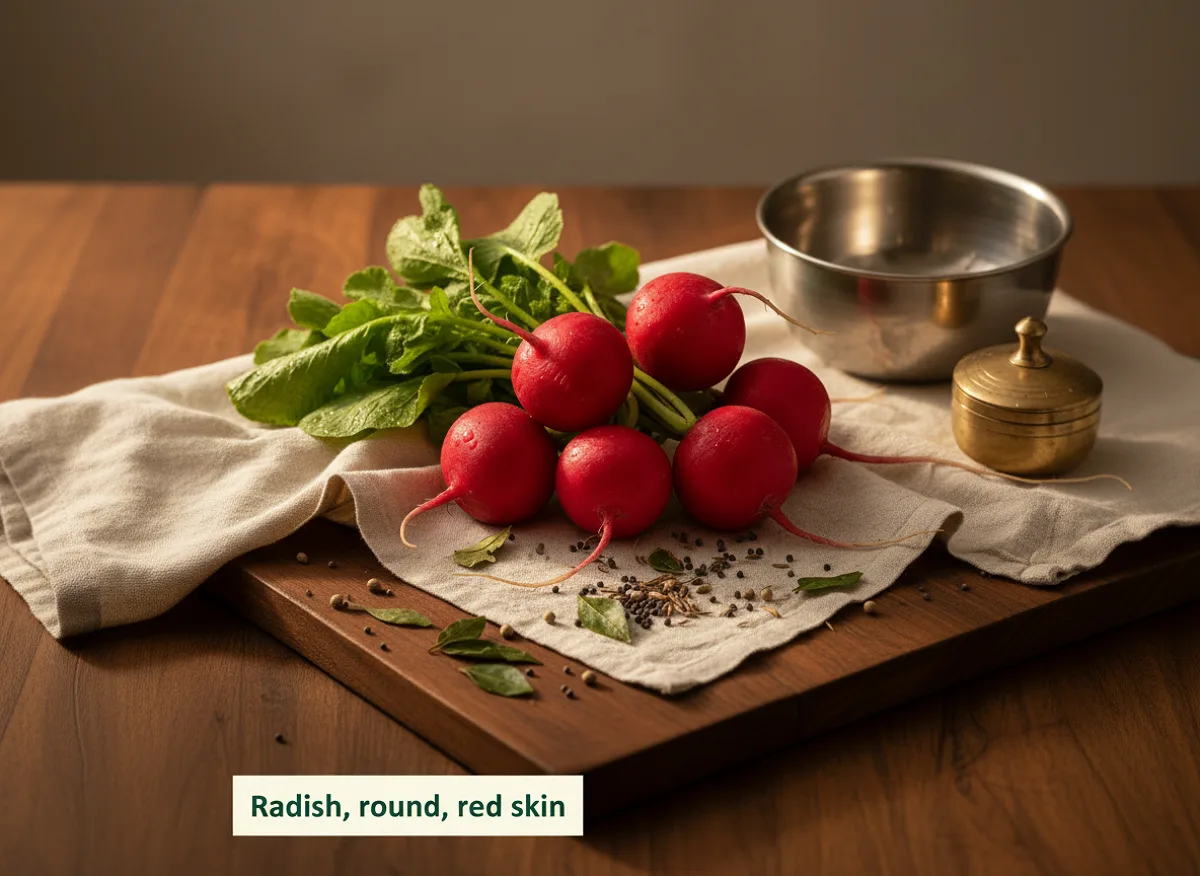
Radish, round, red skin
Raphanus sativus · Also known as Mula, Muda, Muli, Mullangi, Muli pyllon, Gonglu, Moolikaa
Radish, round, red skin (मूली) is a crisp, peppery root vegetable widely used across Indian kitchens in fresh salads, pickles, and cooked sabzis. Rich in vitamin C and fibre, it brings a refreshing bite to everyday meals (IFCT 2017, Ref #F011).
Nutrition per 100 g
Edible portion values from the master catalog.
More macros
Classification
About Radish, round, red skin
What it is
A small, round root vegetable with bright red or pink skin and crisp white flesh inside. Native to Asia, radish (मूली in Hindi) is one of India's most accessible and affordable vegetables, eaten raw or cooked depending on season and region. It belongs to the Brassicaceae family and is documented in Indian food composition tables as a nutrient-dense root vegetable (IFCT 2017, Ref #F011).
Use in Indian Kitchen
Radish holds a quiet, everyday place in Indian home cooking. In North India, thin slices appear on the side of a thali, often with a pinch of salt and chaat masala - a cooling, crunchy contrast to warm dal and roti. In the South, radish is grated into sambhar or cooked into a mild, buttery sabzi. Pickled radish (मूली का अचार) is a monsoon staple in many households, sharp and tangy alongside rice and ghee. Winter markets overflow with fresh radish; it is traditionally believed to aid digestion and cool the body. The leaves, too, are not wasted - ground into a tadka or added to dal, they carry an earthy, slightly bitter note that older generations prize.
Key Nutrients
Radish is a good source of vitamin C, dietary fibre, and potassium. It also contains small amounts of folate, calcium, and manganese. The peppery compounds that give radish its bite are glucosinolates, which are being studied for their potential antioxidant properties. Exact nutrient composition per 100 g is documented in IFCT 2017, Ref #F011.
Health Benefits (Evidence-based)
- May support digestive health through its fibre content and traditional use as a digestive aid in Ayurvedic and home medicine.
- High in vitamin C, which supports immune function and skin health.
- Low in calories and high in water content, making it a hydrating, weight-friendly vegetable.
- Contains compounds linked to anti-inflammatory and antioxidant activity, though human studies in Indian populations remain limited.
- Traditionally used to support liver and kidney function in classical Indian wellness practices.
Culinary Uses (Vegetarian)
- Raw slices with salt and chaat masala as a side dish or in salads.
- Grated into sambhar, rasam, or vegetable curries.
- Cooked as a mild sabzi with mustard seeds, cumin, and turmeric.
- Pickled (अचार) for long storage and tangy flavour.
- Leaves ground into a tadka or added to dal and khichdi.
- Sliced thin and layered in parathas or stuffed breads.
Caution
- Raw radish in large quantities may cause mild bloating or gas in sensitive individuals; cooking softens this effect.
- Those with thyroid conditions should consume in moderation, as Brassicaceae vegetables contain goitrogens, though cooking reduces this concern.
- Radish may interact with certain medications affecting blood sugar or blood pressure; consult a healthcare provider if on long-term medication.
References
- Indian Council of Medical Research - National Institute of Nutrition (ICMR-NIN). Indian Food Composition Tables (IFCT) 2017. Reference #F011 (Root and Tubers category).
- National Institute of Nutrition, ICMR. Dietary Guidelines for Indians - A Manual. New Delhi: NIN Publications.
Sourcing & Storage
Storage
Store radish in a cool, dry place or in the refrigerator's vegetable drawer, ideally in a perforated plastic bag or cloth to allow air circulation. Keep away from direct sunlight and moisture. If radish leaves are attached, remove them before storage as they draw moisture from the root. In Indian homes, radish keeps well in a cool corner of the kitchen during winter; in warmer months, refrigeration extends freshness.
Shelf Life
Fresh, whole radish lasts 2 to 3 weeks when stored in the refrigerator. Once cut or sliced, use within 2 to 3 days. Pickled radish, when properly sealed in oil or brine, keeps for several months in a cool, dark cupboard. Radish leaves, if stored separately in a damp cloth in the fridge, remain usable for 3 to 5 days.
Check Before You Buy
Choose radishes that are firm, smooth, and free of soft spots, cracks, or blemishes. The skin should be bright red or pink with no dull patches or mould. Avoid radishes that feel spongy or hollow when squeezed - a sign of age or poor storage. If buying from a mandi or kirana shop, pick smaller to medium-sized radishes, as very large ones can be woody and less tender. Leaves, if present, should be fresh and green, not yellowed or wilted. Pre-packed radishes in supermarkets should be checked for moisture inside the bag, which can lead to rot.