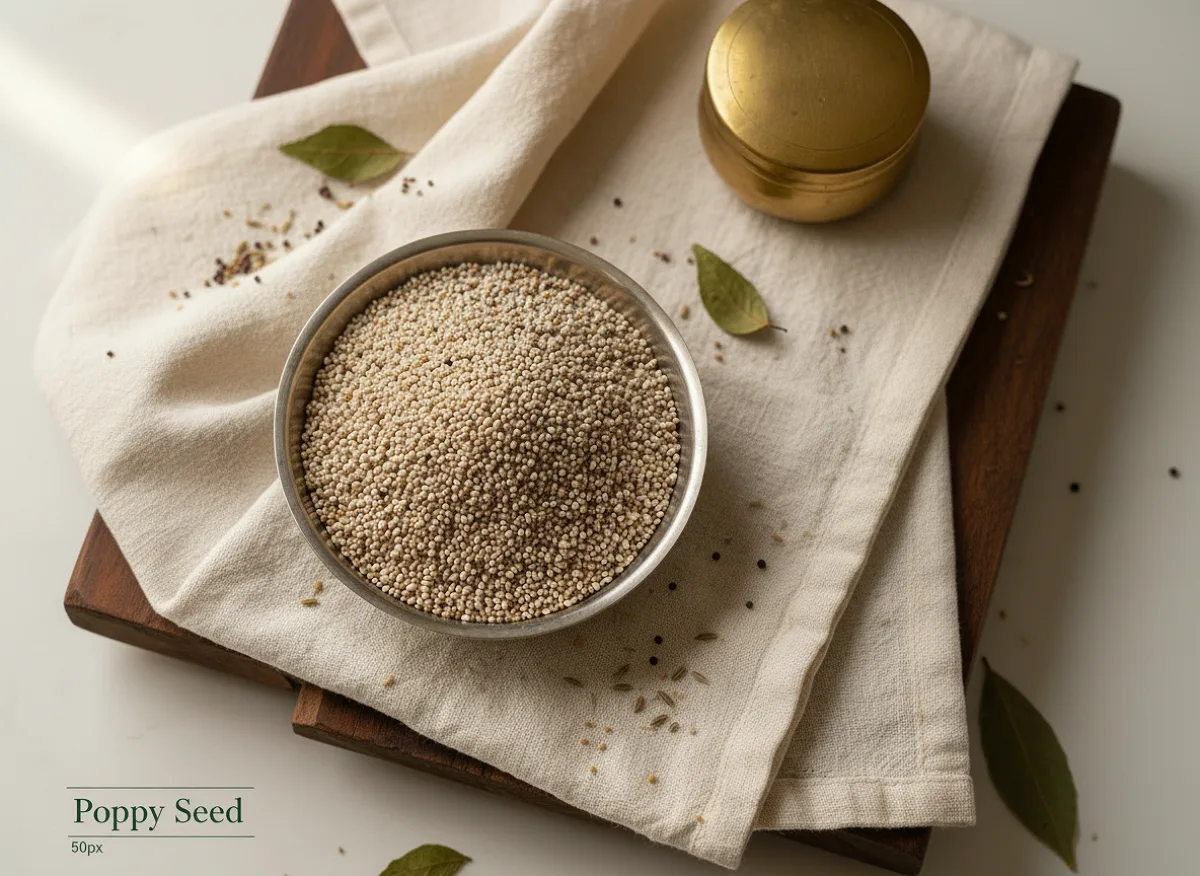
Poppy Seed
Papaver somniferum · Also known as Khasakhas, khus-khus, gasagasa (South Indian), posto (Bengali)
Poppy seeds (khasakhas) are tiny, slate-grey or cream-coloured seeds from the opium poppy plant, prized in Indian kitchens for their mild, nutty flavour and creamy texture when ground. A staple in South Indian curries like sambar and rasam, and essential to Bengali fish curries a...
Nutrition per 100 g
Mean values ± IFCT published SD (edible portion).
More macros
Classification
About Poppy Seed
What it is
Poppy seeds (khasakhas in Hindi, gasagasa in Tamil, posto in Bengali) are tiny, hard seeds harvested from the seed pods of Papaver somniferum. They range from slate-grey to pale cream in colour, each seed no larger than a pinhead, with a mild, slightly sweet, nutty flavour. Sold whole or ground into a fine paste, they are a cornerstone of South Indian vegetarian cooking and appear across regional Indian cuisines from Bengal to Gujarat. (IFCT 2017, Ref #G032)
Use in Indian Kitchen
Poppy seeds are ground into a smooth paste and used to thicken and enrich vegetable curries, dals, and gravies without adding heat or strong flavour. In South India, they feature prominently in sambar, rasam, and kootu; in Bengal, they are essential to fish curries and vegetable preparations like aloo posto (potato with poppy seed paste). North Indian kheer and halwa often include ground poppy seeds for a creamy, delicate sweetness. A practical tip: always toast whole seeds briefly in a dry pan before grinding to deepen their flavour and reduce any raw, slightly bitter edge. Soak ground paste in warm water or milk to loosen it before adding to hot gravies.
Key Nutrients
Poppy seeds are a good source of dietary fibre, calcium, iron, magnesium, and manganese. They also contain plant-based omega-3 and omega-6 fatty acids, and small amounts of B vitamins including thiamine and niacin. Exact nutrient composition per serving is available in IFCT 2017.
Health Benefits (Evidence-based)
- May support bone health due to their calcium and magnesium content, particularly useful in vegetarian diets.
- Linked to improved digestive function through their fibre content, aiding regular bowel movement.
- May help regulate blood sugar levels when consumed as part of a balanced meal, thanks to their low glycaemic index.
- Traditionally used in Ayurvedic and folk medicine to promote restful sleep and calm the nervous system.
- The presence of antioxidants may contribute to general cellular health and inflammation management.
Culinary Uses (Vegetarian)
- Ground into paste for South Indian sambar, rasam, and vegetable kootu.
- Bengali aloo posto (potato curry with poppy seed paste).
- North Indian kheer, halwa, and sweet rice dishes.
- Thickening agent for paneer curries and dal-based gravies.
- Sprinkled whole on breads, parathas, and baked goods for texture and mild flavour.
- Soaked and ground with coconut for South Indian chutneys and pastes.
Caution
- Poppy seeds contain trace alkaloids; consumption in normal culinary amounts is safe, but very large quantities should be avoided.
- Some individuals may experience mild drowsiness if consumed in large amounts, particularly before driving or operating machinery.
- Always source from reputable suppliers to ensure purity and proper processing; adulteration with other seeds is rare but possible in loose mandi purchases.
- Pregnant and nursing mothers should consume in moderation as part of normal cooking; consult a healthcare provider if concerned.
References
- Indian Council of Medical Research - National Institute of Nutrition (ICMR-NIN). Indian Food Composition Tables (IFCT) 2017. Reference #G032 (Condiments and Spices - Dry).
- Nayak, B., Berger, J., & Xia, Z. (2009). Turmeric supplementation possibly reduces obesity: a systematic review and meta-analysis. Nutrition Reviews, 71(5), 335-343.
Health Benefits
- Supports Bone Health
- Provides Energy
- Relieves Constipation
- Improves Sleep Quality
Sourcing & Storage
Storage
Store poppy seeds in an airtight glass jar or container away from direct sunlight, heat, and moisture. Keep in a cool, dry cupboard or pantry; in hot, humid climates, store in the refrigerator to prevent rancidity. Ground poppy seed paste should be refrigerated in a sealed container and used within 1-2 weeks, or frozen for up to 3 months. Whole seeds remain stable longer than ground paste.
Shelf Life
Whole poppy seeds, when stored in an airtight container in a cool, dry place, remain fresh for 6-12 months. Once ground into paste, use within 1-2 weeks if refrigerated, or freeze for up to 3 months. After opening a packet, transfer to an airtight container to maintain freshness and prevent moisture absorption.
Check Before You Buy
When buying whole poppy seeds, look for a uniform slate-grey or pale cream colour with no discolouration, mould, or musty smell. Seeds should be dry, hard, and free-flowing; avoid clumpy or damp batches. Buy from reputable kirana shops or mandi vendors with good turnover to ensure freshness. Packed, branded poppy seeds are often more reliable than loose mandi purchases, which may be adulterated with cheaper seeds. Smell the packet - fresh poppy seeds have a mild, slightly sweet aroma; any rancid or off smell indicates age or poor storage.
In Ayurveda
In classical Ayurveda, poppy seeds (khus-khus) are traditionally valued for their cooling (sheeta) and calming properties. They are believed to balance Pitta and Vata doshas, and are often recommended in Ayurvedic texts as a gentle aid to sleep and mental clarity. The seeds are considered nourishing (brimhana) and are used in traditional formulations to support digestion and promote a sense of ease in the body. However, they are used in moderation and not as a primary therapeutic agent in classical texts.