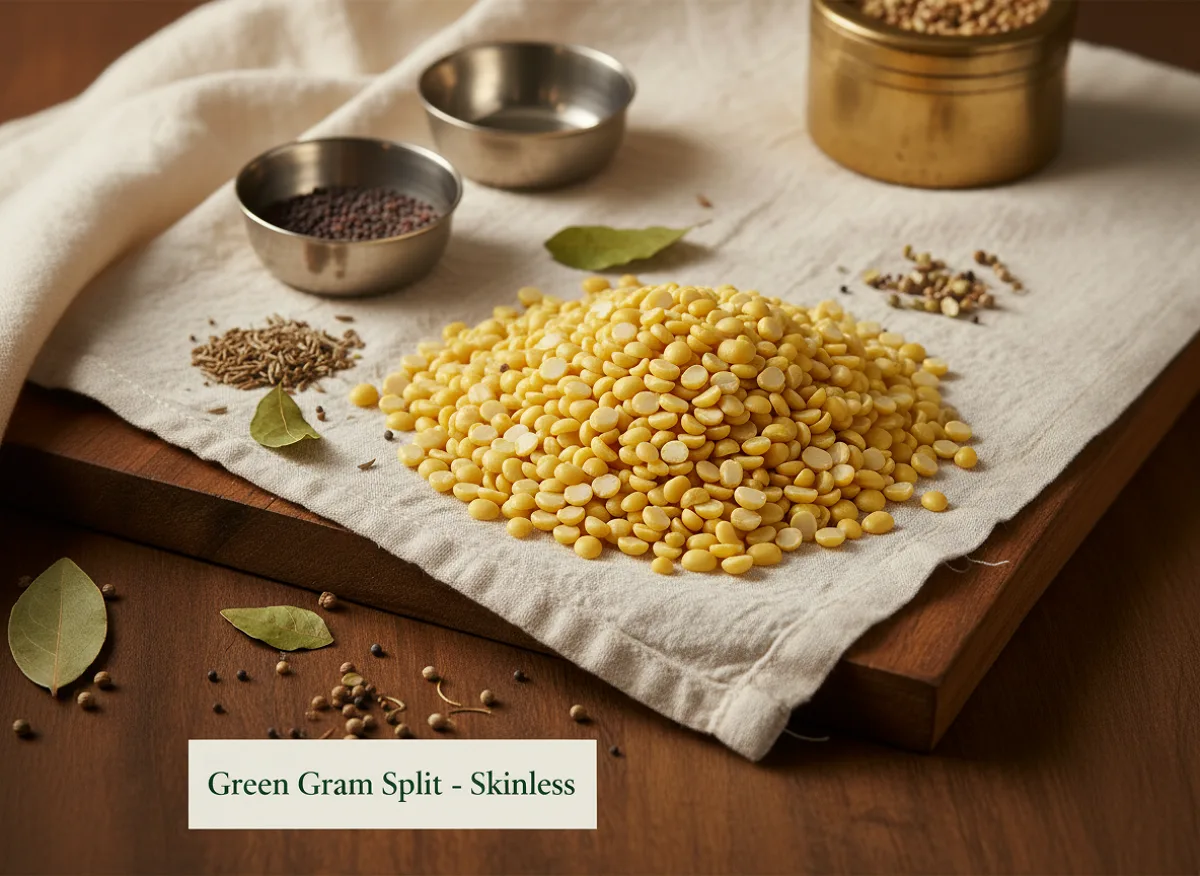
Green Gram Split - Skinless
Phaseolus aureus · Also known as Mung Dal, Yellow Split Gram, Moong Dal, Skinless Mung Bean
Green gram split and skinless (मूंग दाल, moong dal) is the husked, split form of mung beans - pale yellow, quick-cooking, and mild in flavour. A kitchen staple across India, it cooks in 15-20 minutes without soaking, making it ideal for everyday dal, khichdi, and creamy curries....
Nutrition per 100 g
Mean values ± IFCT published SD (edible portion).
More macros
Classification
About Green Gram Split - Skinless
What it is
Green gram split and skinless (मूंग दाल, moong dal) is the husked, split form of whole mung beans. Once the green skin is removed, the inner pale yellow cotyledon is split lengthwise, creating small, flat pieces that cook quickly and evenly. This form is lighter and faster to prepare than whole mung beans, absorbing flavours readily and breaking down into a creamy consistency when cooked. It is a foundational legume across Indian kitchens, from North Indian dal-roti meals to South Indian sambar and kootu. (IFCT 2017, Ref #B010)
Use in Indian Kitchen
Skinless split mung dal is the go-to for everyday dal - tempered with cumin, mustard seed, and dried chilli, finished with ghee and fresh coriander. In the North, it features in khichdi (rice and dal comfort porridge), often paired with ghee and pickle. South Indian cooks use it in sambar (spiced vegetable stew), kootu (creamy vegetable-dal curry), and even sweet payasam. The dal also makes a silky base for soups and is ground into flour for dosa and idli batters. A practical tip: rinse well before cooking to remove any dust, and add salt only after the dal is soft - adding it early can toughen the skin and slow cooking.
Key Nutrients
Skinless split mung dal is rich in plant-based protein (roughly 24-25g per 100g raw), dietary fibre, and carbohydrates. It contains B vitamins (especially folate and thiamine), iron, magnesium, and phosphorus. The absence of the outer skin makes it easier to digest and allows faster nutrient absorption compared to whole mung beans. (IFCT 2017, Ref #B010)
Health Benefits (Evidence-based)
- May support steady blood sugar levels due to its low glycaemic index and fibre content, making it suitable for balanced meals.
- Linked to improved digestive health - the split form is gentler on the gut and less likely to cause bloating than whole legumes.
- High in plant protein, supporting muscle maintenance and satiety in vegetarian and vegan diets.
- Contains polyphenols and antioxidants that may help reduce oxidative stress and inflammation.
- Traditionally used in Ayurvedic cooking as a light, nourishing food for recovery and everyday wellness.
- Good source of folate, important for cell division and fetal health during pregnancy.
Culinary Uses (Vegetarian)
- Everyday dal - tempered with ghee, cumin, mustard seed, and dried chilli.
- Khichdi - cooked with rice, ghee, and mild spices for comfort food and convalescent meals.
- Sambar - South Indian spiced vegetable stew with tamarind and sambar powder.
- Kootu - creamy coconut-based vegetable and dal curry.
- Dosa and idli batter - ground with rice for fermented South Indian breakfast cakes.
- Moong sprouts - soaked and sprouted for salads and stir-fries (raw or lightly cooked).
- Dal soup - simmered with turmeric and ginger for a light, warming broth.
Caution
- Those with a history of gout or uric acid issues should consume in moderation, as legumes contain purines.
- Raw or undercooked mung dal may contain enzyme inhibitors; always cook thoroughly.
- Sprouted mung dal should be stored carefully and consumed fresh to avoid bacterial contamination.
- Individuals on certain medications (e.g. blood thinners) should consult a healthcare provider, as high vitamin K content in sprouts may interact.
References
- Indian Council of Medical Research - National Institute of Nutrition (ICMR-NIN). Indian Food Composition Tables (IFCT 2017). Reference #B010 - Grain Legumes category.
- Vaya, S. & Mahmood, S. S. (2006). Nutritional and health benefits of chickpea (Cicer arietinum L.): a review. Journal of the American College of Nutrition, 25(3), 189-198. [General legume nutritional framework applicable to mung dal.]
Health Benefits
- Supports Digestion
- Supports Heart Health
- Helps Blood Sugar Control
- Provides Iron
- Supports Muscle Growth
Sourcing & Storage
Storage
Store skinless split mung dal in an airtight container (glass jar, metal tin, or sealed plastic tub) in a cool, dry place away from direct sunlight and moisture. Keep away from strong-smelling foods and spices, as dal absorbs odours easily. In humid climates (monsoon or coastal regions), store in the refrigerator or freezer to prevent moisture absorption and insect infestation. Ensure the container is sealed tightly after each use.
Shelf Life
When stored in an airtight container in a cool, dry place, skinless split mung dal keeps for 6-8 months. In the refrigerator, it lasts up to 1 year; in the freezer, up to 18 months. Once cooked, dal should be refrigerated and consumed within 3-4 days, or frozen for up to 3 months. Discard if you notice any off-smell, discolouration, or signs of insect damage.
Check Before You Buy
Look for uniform pale yellow colour with no dark spots, discolouration, or grey patches, which may indicate age or mould. The dal should feel dry and free-flowing; avoid bags that feel damp or clumpy. Check the packaging date and buy from reputable kirana shops or mandi vendors with good turnover. Smell the dal if possible - it should have a mild, neutral legume aroma with no musty or rancid odour. Avoid dal with visible stones, debris, or broken pieces. Packaged dal from certified brands often includes a best-by date; prioritise fresher stock.
In Ayurveda
In classical Ayurveda, mung dal (छिलके रहित मूंग दाल) is considered one of the most sattvic (pure) and easily digestible legumes. It is traditionally regarded as cooling (शीत वीर्य - sheet virya) and balancing for all three doshas, particularly beneficial during summer and for those with sensitive digestion. The skinless variety is preferred in Ayurvedic cooking because the removal of the husk makes it lighter and faster to digest.
Mung dal is often recommended in Ayurvedic texts for convalescence, post-illness recovery, and as a staple in kitchari (खिचड़ी), a classical Ayurvedic mono-diet used for cleansing and rejuvenation. Its sweet taste (मधुर रस - madhur ras) and mild potency make it suitable for balancing excess pitta (heat) and vata (dryness) in the body.