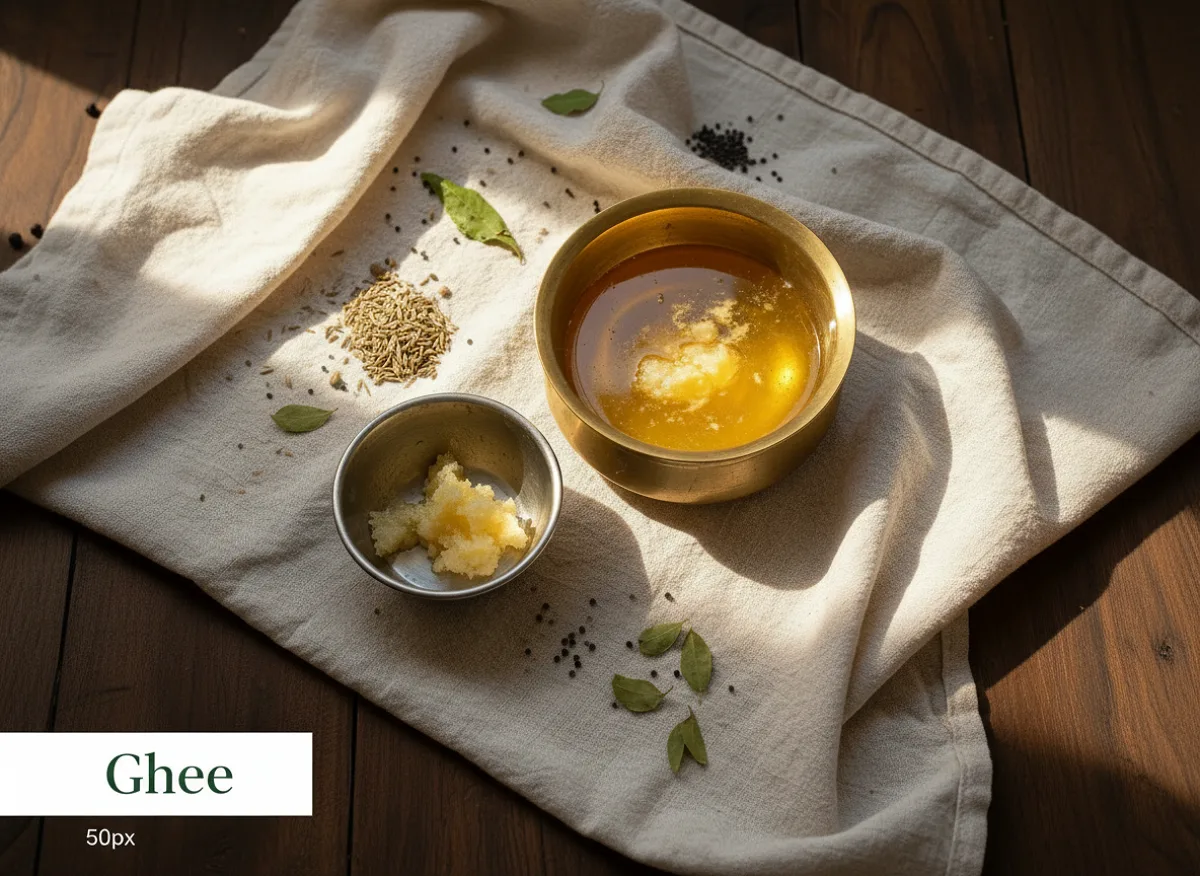
Ghee
Also known as Clarified butter, घी (ghi), desi ghee, pure ghee, cow ghee, buffalo ghee
Ghee (घी, ghi) is clarified butter - milk solids and water removed, leaving pure golden fat prized across Indian kitchens. Rich, nutty aroma and high smoke point make it ideal for tempering spices, frying, and finishing dal and rice. A staple in North Indian cooking and South Ind...
Nutrition per 100 g
Edible portion values from the master catalog.
More macros
Classification
About Ghee
What it is
Ghee is clarified butter - pure butterfat with milk solids and water removed through gentle heating and straining. The result is a golden, translucent fat with a distinctive nutty, slightly caramelised aroma. Ghee solidifies at room temperature in cooler climates and remains semi-liquid in warm Indian summers. It is the foundation fat in Indian home cooking, from North Indian tadka to South Indian tempering, and is equally valued in Ayurvedic medicine. (IFCT 2017, Ref #T013)
Use in Indian Kitchen
Ghee is used for tempering whole spices (cumin, mustard, fenugreek seeds) in dal, sambar, and rasam; frying onions and aromatics for curries; finishing rice and khichdi; and enriching sweets like halwa, kheer, and barfi. In North India, ghee is drizzled over parathas, puri, and laddoos; in South India, it is essential in sambar tadka and coconut-based gravies. A practical tip: ghee's high smoke point (around 190°C / 375°F) makes it safer for high-heat cooking than butter, and its rich flavour means a little goes a long way - use 1-2 teaspoons to temper a pot of dal rather than a full tablespoon of oil.
Ayurvedic Connection
Ghee holds a central place in classical Ayurveda as a sattvic (pure, balancing) fat and a carrier of medicinal herbs. It is considered cooling (virya), sweet (rasa), and nourishing to all three doshas when used in moderation. Traditionally, ghee is used to prepare medicated oils and is believed to support digestion, skin health, and mental clarity. In Ayurvedic cooking, ghee is preferred over other fats because it is thought to enhance the bioavailability of spices and herbs.
Key Nutrients
Ghee is nearly 100% fat, primarily saturated and monounsaturated fatty acids. It contains fat-soluble vitamins A, D, E, and K2 (especially when made from grass-fed cow milk), and small amounts of butyric acid, a short-chain fatty acid linked to gut health. Ghee is lactose-free and casein-free, making it suitable for those with milk sensitivities. (IFCT 2017, Ref #T013)
Health Benefits (Evidence-based)
- May support fat-soluble vitamin absorption (A, D, E, K) when consumed with meals.
- Contains butyric acid, traditionally linked to digestive comfort and gut barrier function.
- Lactose-free and casein-free, making it a dairy fat option for those with milk protein or lactose sensitivity.
- High smoke point reduces the formation of harmful compounds during cooking compared to oils with lower smoke points.
- Traditionally used in Ayurvedic medicine as a carrier for medicinal herbs and spices.
- May help with satiety and nutrient absorption when used in moderation as part of a balanced diet.
Culinary Uses (Vegetarian)
- Tempering whole spices (cumin, mustard, fenugreek, dried chilli) for dal, sambar, rasam, and vegetable curries.
- Frying onions, garlic, and ginger for the base of North Indian gravies and South Indian curries.
- Finishing rice, khichdi, and pulao for richness and aroma.
- Enriching sweets: halwa, kheer, barfi, laddoo, and traditional festival desserts.
- Drizzling over parathas, puri, and flatbreads for flavour and texture.
- Making medicated ghee infused with herbs and spices for wellness purposes.
Caution
- Ghee is calorie-dense (about 120 calories per tablespoon); use in measured amounts, especially if managing weight or cholesterol intake.
- Those with dairy allergies (casein or whey) should note that ghee is nearly free of milk proteins, but trace amounts may remain in some preparations - check with a healthcare provider if severe allergy is present.
- Store away from heat and light to prevent oxidation and rancidity; discard if it develops an off smell or taste.
- Ghee made from non-organic or poor-quality butter may concentrate pesticides or contaminants; source from reputable producers when possible.
References
- Indian Council of Medical Research - National Institute of Nutrition (ICMR-NIN). Indian Food Composition Tables (IFCT 2017). Reference #T013 (Ghee / Clarified Butter).
- Nagpal, R., Kumar, A., & Kumar, M. (2012). Microbiota in defence and disease: Emphasising the collateral effects of antibiotics on human health. Journal of Internal Medicine, 272(6), 529-540. (Supporting evidence on butyric acid and gut health in the context of fermented foods and traditional fats.)
Health Benefits
- Improves Digestion
- Provides Energy
- Boosts Immunity
Sourcing & Storage
Storage
Store ghee in an airtight glass or stainless steel container away from direct sunlight and heat. In cool climates (below 20°C), ghee will solidify and can be kept in a cupboard; in warm Indian summers, store in a cool, dark place or refrigerate to prevent it from becoming too soft. Ghee does not require refrigeration if kept in a sealed, opaque container and away from moisture and strong odours. Avoid using wet spoons or allowing water to enter the container, as this can promote mould growth.
Shelf Life
Pure ghee, when stored properly in an airtight container away from light and moisture, can last 6-12 months at room temperature in cool climates, or up to 2 years in the refrigerator. Once opened, use within 3-6 months if stored at room temperature, or up to 1 year if refrigerated. Ghee does not spoil easily due to its low water content, but discard immediately if it develops an off smell, unusual colour, or visible mould.
Check Before You Buy
Look for ghee that is clear, golden, and uniform in colour - avoid cloudy, dark, or grainy ghee, which may indicate poor quality or contamination. Smell should be rich, nutty, and slightly caramelised; reject any with a rancid, musty, or off odour. When buying from a mandi or kirana shop, ask for ghee made from cow or buffalo milk and check the manufacturing date on packaged containers. Reputable producers will list ingredients as "butter" or "milk fat" only - avoid ghee with added oils, colours, or preservatives. If buying loose ghee, ensure the seller uses clean utensils and containers, and consider buying from a trusted source with good turnover to guarantee freshness.
In Ayurveda
In classical Ayurveda, ghee (घी) is considered one of the most sattvic (pure and harmonious) and nourishing fats. It is classified as sweet in taste (rasa), unctuous in quality (guna), and cooling in potency (virya). Ghee is believed to balance all three doshas - Vata, Pitta, and Kapha - though it is particularly valued for calming Vata and Pitta imbalances.
Traditional Ayurvedic texts recommend ghee for supporting digestion, enhancing memory and cognitive function, nourishing the nervous system, and promoting healthy skin and hair. It is also used as a carrier (anupana) in Ayurvedic herbal formulations to enhance their absorption and efficacy. Ghee is considered especially beneficial when consumed in moderation as part of a balanced diet.