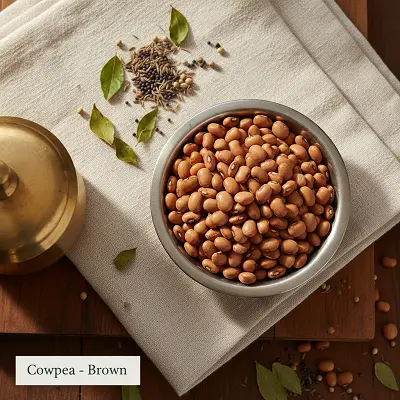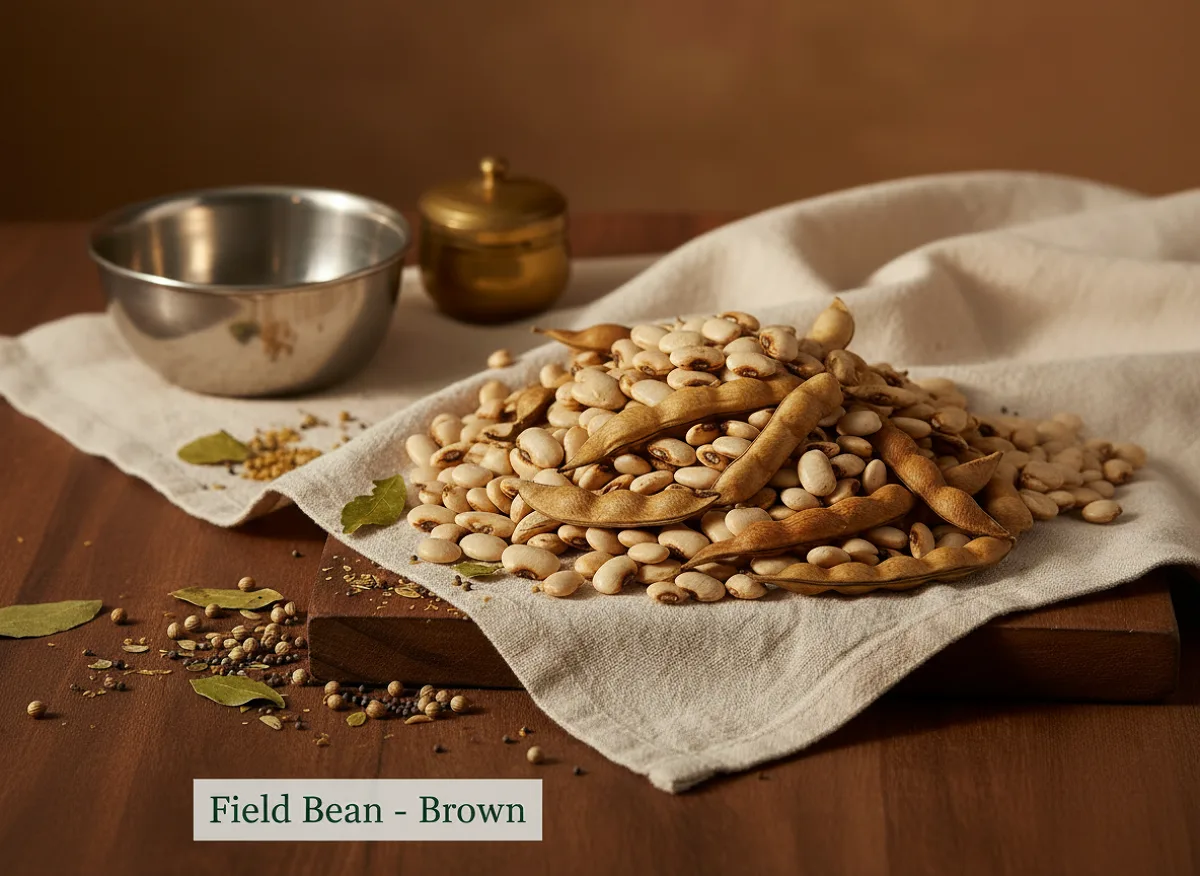
Field Bean - Brown
Phaseolus vulgaris · Also known as Broad bean, pheeld been - bhoora, fava bean, avarekalu (Kannada), pavta (Marathi), sem (Hindi)
Field bean - brown (also called broad bean or pheeld been - bhoora) is a sturdy legume with flat, cream-coloured seeds inside thick pods. Dried and cooked, it turns soft and earthy, holding its shape well in curries and dal preparations. Common in South Indian sambar and rasam, a...
Nutrition per 100 g
Edible portion values from the master catalog.
More macros
Classification
About Field Bean - Brown
What it is
Field bean - brown (पीली सेम, pili sem or sem in Hindi; avarekalu in Kannada) is a dried legume with pale, flat seeds that swell and soften when cooked. The pods are thick and fibrous, but the dried seeds are what reach your kitchen - whole, cream-coloured, and ready to be soaked and cooked into dal, curry, or mixed vegetable dishes. Widely grown across India and a staple in South Indian temple kitchens and North Indian home cooking, this bean is valued for its mild flavour and creamy texture when cooked. (IFCT 2017, Ref #B008)
Use in Indian Kitchen
Field beans shine in sambar, where they cook down into a soft, flavourful base alongside tamarind and spices. In the South, they are also cooked into rasam and mixed vegetable kootu with coconut and cumin. North Indian cooks blend them into mixed dal preparations or cook them simply with turmeric, cumin, and a tadka of ghee and asafoetida. A practical tip: soak overnight to reduce cooking time and aid digestion; the soaking water can be discarded and fresh water used for cooking. Pairing with tamarind, jaggery, or a squeeze of lemon mellows any earthiness and brightens the dish.
Key Nutrients
Field beans are a good source of plant-based protein, dietary fibre, and carbohydrates. They also contain iron, phosphorus, and B vitamins including folate. Exact nutrient composition is documented in IFCT 2017 (Ref #B008); values vary slightly depending on growing conditions and storage.
Health Benefits (Evidence-based)
- High in plant protein and fibre, supporting steady energy and digestive health.
- May help maintain stable blood sugar levels when part of a balanced meal.
- Iron and folate content supports red blood cell formation and overall vitality.
- Traditionally used in Ayurvedic cooking as a grounding, nourishing legume for all constitutions.
- Fibre content may support heart health and cholesterol management.
Culinary Uses (Vegetarian)
- Sambar - cooked soft and blended into the spiced tamarind base.
- Rasam - added whole or partially mashed for body and protein.
- Mixed vegetable kootu with coconut, cumin, and curry leaves.
- Simple dal with turmeric, cumin, and a ghee tadka.
- Mixed dal preparations (dal mixes) for everyday comfort meals.
- Pressure-cooked and seasoned with onion, tomato, and spices as a standalone curry.
Caution
Field beans contain compounds that may cause bloating or gas in sensitive individuals; soaking and discarding the water, and cooking thoroughly, helps reduce this. Those with a history of gout or uric acid issues should consume in moderation, as legumes are purine-rich. Always cook thoroughly - raw or undercooked beans should not be eaten.
References
- Indian Council of Medical Research - National Institute of Nutrition (ICMR-NIN). Indian Food Composition Tables (IFCT 2017). Reference #B008 (Grain Legumes category).
- Gopalan, C., Rama Sastri, B. V., & Balasubramanian, S. C. (2016). Nutritive Value of Indian Foods. National Institute of Nutrition, ICMR, Hyderabad.
Health Benefits
- Supports Digestion
- Supports Heart Health
- Helps Blood Sugar Control
- Provides Iron
- Provides Satiety
Sourcing & Storage
Storage
Store dried field beans in an airtight container (glass jar, metal tin, or sealed cloth bag) in a cool, dry place away from direct sunlight and moisture. Keep away from strong-smelling foods and spices, as legumes absorb odours easily. In humid climates (monsoon or coastal regions), store in the refrigerator or freezer to prevent moisture absorption and pest infestation. Ensure the container is sealed tightly after each use.
Shelf Life
Dried field beans keep well for 6-12 months when stored in an airtight container in a cool, dry place. In humid conditions or after opening, use within 3-6 months for best quality and cooking time. Once cooked, refrigerate in an airtight container for up to 3-4 days, or freeze for up to 3 months.
Check Before You Buy
Look for beans that are uniform in colour (pale cream), whole, and free from cracks, discolouration, or insect holes. Avoid beans that feel damp, smell musty, or show signs of mould. If buying from a mandi or loose from a kirana shop, check a handful for debris, stones, or shrivelled beans. Packed beans should have a clear date and be sealed; avoid packs that feel loose or have condensation inside.
In Ayurveda
In Ayurveda, brown field beans are considered vata-balancing and are valued for their grounding, nourishing properties. The beans carry a sweet (madhura) and astringent (kashaya) taste with heavy (guru) and unctuous (snigdha) qualities. Traditionally, they have been used to support digestive strength (agni) and build bodily tissues (dhatu), particularly in cases of general weakness or depletion. The beans are believed to help stabilise vata dosha when prepared with warming spices and ghee.