Cashew Nut
Anacardium occidentale · Also known as kaajoo, kaju, cashew kernel, cashew
Cashew nut (काजू, kaajoo) is the creamy, kidney-shaped kernel from the cashew apple tree, prized across Indian kitchens for its buttery texture and mild sweetness. Whole roasted cashews are eaten as a snack or garnish; ground into paste for gravies, desserts, and kheer; or fried...
Nutrition per 100 g
Mean values ± IFCT published SD (edible portion).
More macros
Classification
About Cashew Nut
What it is
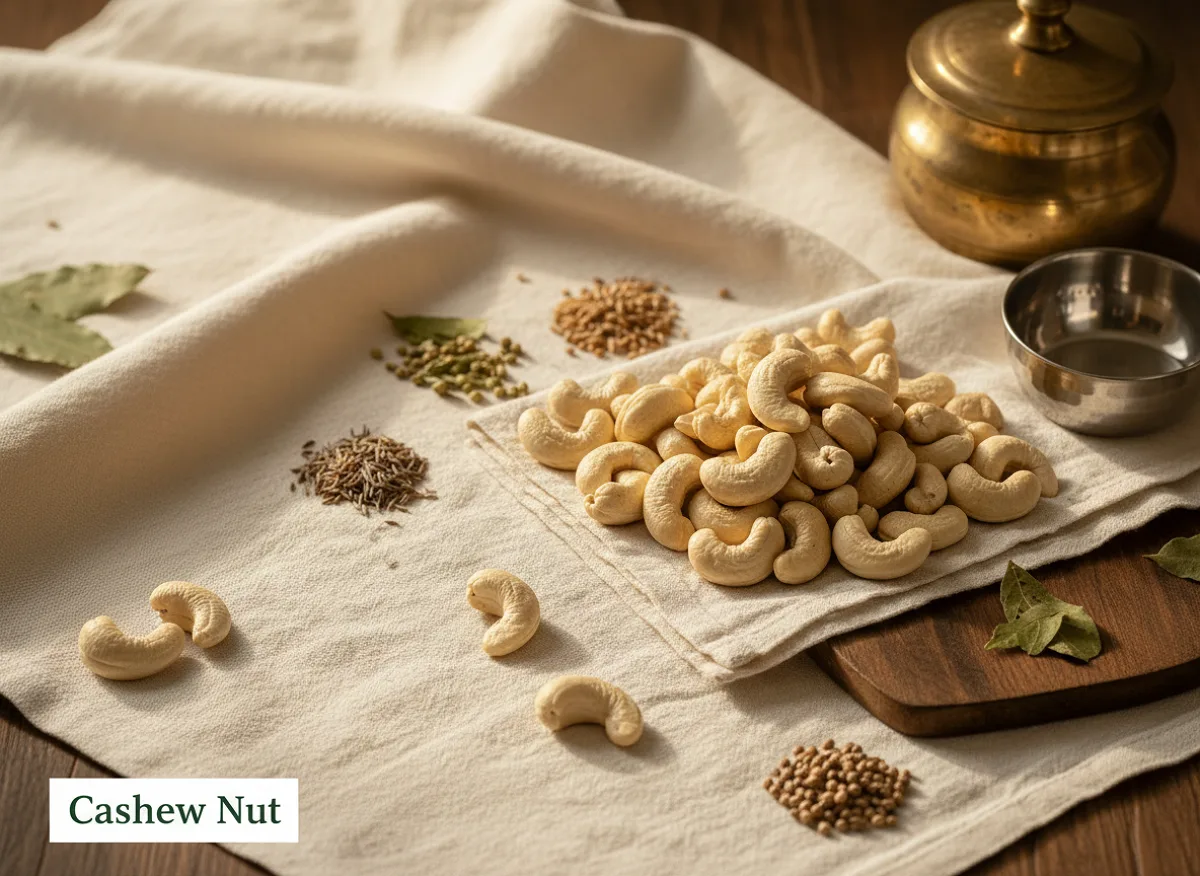
Cashew nut (काजू, kaajoo) is the edible kernel of the cashew apple, a tropical tree native to Brazil but now widely cultivated in India, particularly in Kerala, Goa, and Maharashtra. The nut is kidney-shaped, pale ivory to light tan in colour, and has a naturally buttery, slightly sweet flavour and soft, creamy texture when raw or lightly roasted. It is sold whole, halved, or as broken pieces, and is one of the most versatile nuts in Indian cooking. (IFCT 2017, Ref #H005)
Use in Indian Kitchen
Cashews are used across Indian regional cuisines in both sweet and savoury dishes. In South India, roasted cashews are fried in ghee and used as a garnish (tadka) in sambar, rasam, and rice dishes; ground cashew paste forms the base of rich kormas and coconut curries. In North India, cashews are crushed into Mughlai gravies, biryani, and halwas. They are also ground into a fine paste for kheer, payasam, and barfi. A practical tip: soak raw cashews briefly in warm water before grinding to achieve a smoother, creamier paste for gravies and desserts.
Key Nutrients
Cashews are rich in healthy monounsaturated fats, protein, dietary fibre, and minerals including copper, magnesium, phosphorus, zinc, and iron. They also contain B vitamins (thiamine, riboflavin, niacin) and vitamin E. According to IFCT 2017, cashew nuts provide approximately 553 kcal per 100 g, with 12.3 g protein, 43.9 g fat, and 30.2 g carbohydrate.
Health Benefits (Evidence-based)
- May support heart health through monounsaturated fats, which are linked to improved cholesterol profiles.
- Rich in copper and magnesium, minerals traditionally associated with bone strength and energy metabolism.
- Antioxidants and polyphenols in cashews may help reduce oxidative stress and inflammation.
- High protein and fibre content may support satiety and stable blood sugar when eaten in moderation.
- Zinc and iron content supports immune function and oxygen transport in the body.
Culinary Uses (Vegetarian)
- Whole roasted cashews as a snack, trail mix, or garnish in rice and curries.
- Ground into paste for korma, butter paneer, and rich coconut-based gravies.
- Crushed or powdered in North Indian halwas, barfi, and festive sweets.
- Soaked and blended into kheer, payasam, and dessert creams.
- Fried in ghee as a tempering (tadka) in sambar, rasam, and vegetable stir-fries.
- Cashew cream as a dairy-free base for curries and sauces.
Caution
- Cashews are calorie-dense; portion control is important for weight management.
- Tree nut allergy is common; those with nut allergies should avoid.
- Raw cashews in the shell contain toxic oils and should never be eaten; only processed kernels are safe.
- May cause digestive discomfort if eaten in large quantities on an empty stomach.
References
- Indian Council of Medical Research - National Institute of Nutrition (ICMR-NIN). Indian Food Composition Tables (IFCT) 2017. Hyderabad: NIN; 2017.
- Dreher HM, Davenport AJ. Heuristic review of peer-reviewed publications on US (Cashew) production for a 10-year period. Critical Reviews in Food Science and Nutrition. 2013; 53(5): 541-551.
Health Benefits
- Heart Health Support
- Supports Brain Health
- Improves Bone Health
- Boosts Energy
Sourcing & Storage
Storage
Store cashew nuts in an airtight container in a cool, dry place away from direct sunlight and moisture. In warm, humid Indian climates, refrigeration (4-5°C) or freezing (-18°C) is recommended to prevent rancidity and insect infestation. Keep away from strong-smelling foods, as cashews absorb odours easily. Whole nuts in their shell (if available) last longer than shelled kernels.
Shelf Life
Well-stored raw or roasted cashew kernels in an airtight container at room temperature last 2-3 months; refrigerated, they keep for 6-9 months; frozen, up to 12 months. Once opened, consume within 2-4 weeks for best flavour and freshness. Discard if they develop a rancid smell or taste.
Check Before You Buy
Choose cashews that are uniform in colour (pale ivory to light tan), free of dark spots, mould, or discolouration, and have a fresh, mild aroma with no musty or rancid smell. Avoid nuts that feel soft, oily, or sticky, which indicate spoilage or poor storage. When buying from a mandi or kirana shop, ask for recently arrived stock and check the packaging date on sealed packets. Whole halves are preferable to broken pieces if you plan to use them as garnish; broken pieces are economical for grinding into paste.
In Ayurveda
In classical Ayurvedic texts, cashew nuts are recognized for their warming (ushna) and nourishing (brimhana) properties. They are considered beneficial for vata and pitta constitutions when consumed in moderation, as their healthy fats support tissue formation and lubrication. Traditionally, cashews have been used in Ayurvedic preparations to support overall vitality and strength, particularly in convalescence and seasonal wellness routines.