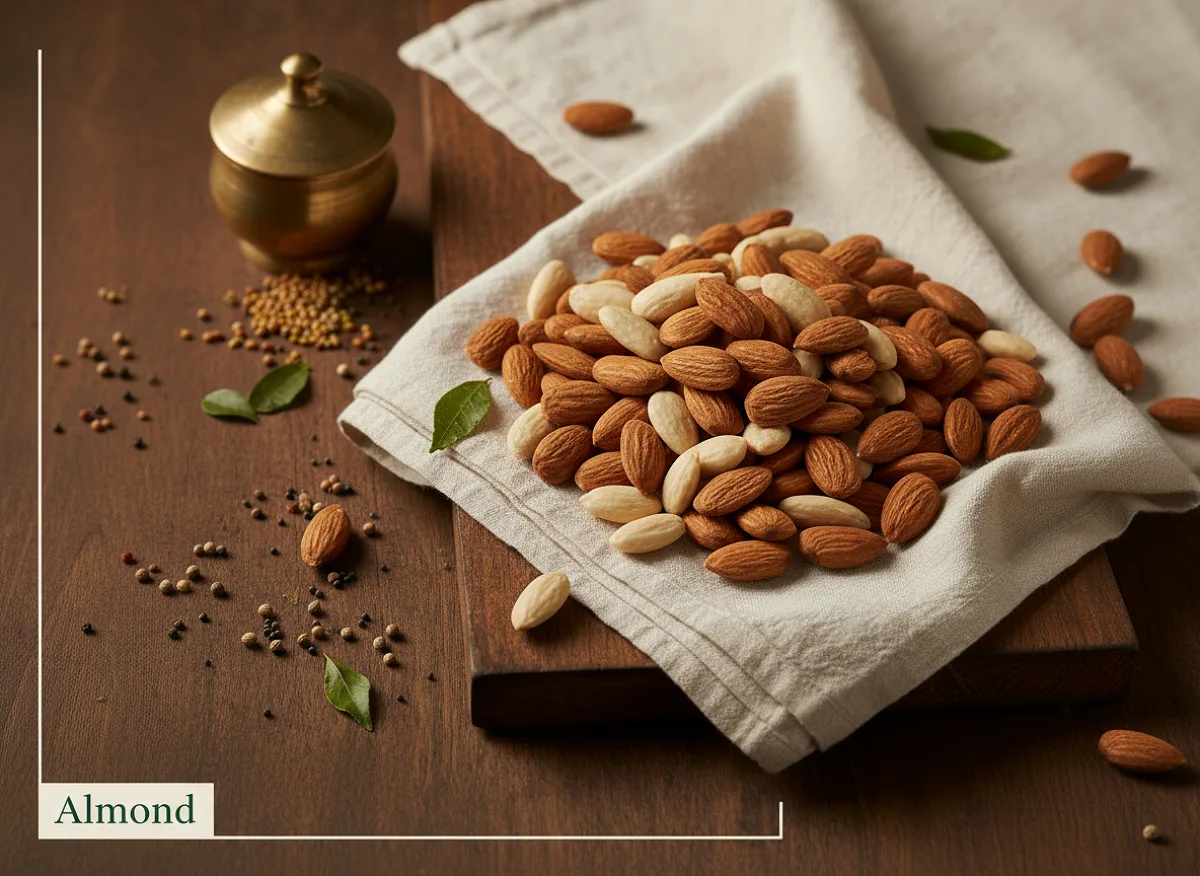
Almond
Prunus amygdalus · Also known as baadaam, badam, almond nut
Almond (baadaam) is a creamy, nutrient-dense nut with a smooth ivory kernel inside a hard brown shell. Whole, sliced, or ground into flour or paste, almonds are a cornerstone of Indian sweets, halwas, and everyday snacking. Soak overnight to soften and aid digestion, or dry roast...
Nutrition per 100 g
Mean values ± IFCT published SD (edible portion).
More macros
Classification
About Almond
What it is
Almond (baadaam) is the edible kernel of the almond tree, enclosed in a hard, ridged shell and thin brown skin. The nut is oval, smooth, and pale cream to ivory in colour, with a mild, slightly sweet, buttery taste. Almonds are sold whole (in shell or blanched), sliced, slivered, or ground into flour or paste, and are a staple across North Indian sweets and South Indian payasams alike. (IFCT 2017, Ref #H001)
Use in Indian Kitchen
Almonds feature prominently in festive halwas (baadaam ka halwa), rich gravies for paneer and vegetable curries, and ground into paste for kheer and payasam. Blanched slivered almonds garnish biryanis, puris, and laddoos; ground almond flour binds cakes and barfis. In South India, almonds are roasted and powdered for chutney bases and payasam thickening. A practical tip: soak whole almonds overnight in water to soften the skin and make them easier to blanch and digest; dry roast before grinding to intensify their nutty depth for gravies and sweets.
Key Nutrients
Almonds are rich in protein, healthy monounsaturated fats, dietary fibre, vitamin E (tocopherol), magnesium, phosphorus, and manganese. They also contain polyphenols and other antioxidant compounds. Exact nutrient composition per 100 g is documented in IFCT 2017.
Health Benefits (Evidence-based)
- May support heart health through their monounsaturated fat and fibre content, linked to healthy cholesterol levels.
- Rich in vitamin E, an antioxidant traditionally valued for skin and immune support.
- High in magnesium, which may help with muscle and nerve function.
- Fibre content may aid digestive regularity when consumed as part of a balanced diet.
- Polyphenols and other plant compounds may contribute to overall antioxidant defence.
- Traditionally used in Ayurvedic tonics and rejuvenation preparations (rasayanas).
Culinary Uses (Vegetarian)
- Whole or blanched slivered almonds as garnish for biryanis, puris, laddoos, and festive sweets.
- Ground into paste for rich gravies, paneer curries, and vegetable dishes.
- Almond flour in cakes, barfis, and gluten-free baking.
- Soaked and blended into kheer, payasam, and milk-based desserts.
- Dry roasted and powdered for chutney bases and spice blends.
- Almond milk as a dairy alternative in modern Indian kitchens.
Caution
- Tree nut allergy: almonds are a common allergen; those with nut allergies must avoid.
- High in calories and fat; portion control recommended for weight management.
- Raw almonds in very large quantities may contain trace amounts of cyanogenic compounds; roasting or blanching neutralises this.
- May interact with certain medications; consult a healthcare provider if on blood thinners or other long-term treatments.
References
- Indian Council of Medical Research - National Institute of Nutrition (ICMR-NIN). Indian Food Composition Tables (IFCT 2017). Hyderabad: NIN; 2017. [Ref #H001 - Nuts and Seeds category]
- Dreher ML, Davenport AJ. Hass avocado composition and potential health effects. Critical Reviews in Food Science and Nutrition. 2013;53(7):738-750. [General reference on tree nut nutrient density and health outcomes in Indian dietary contexts]
Health Benefits
- Weight Management Support
- Heart Health Support
- Improves Skin Health
- Boosts Brain Health
Sourcing & Storage
Storage
Store almonds in an airtight container in a cool, dry place away from direct sunlight and moisture. In warm, humid Indian climates, refrigerate in an airtight jar or sealed container to prevent rancidity and insect infestation. Keep away from strong-smelling foods, as almonds absorb odours easily. Blanched or ground almonds are more prone to spoilage and should always be refrigerated.
Shelf Life
Whole almonds in shell, stored in a cool dry place, keep for 6-12 months. Blanched or shelled almonds last 3-6 months at room temperature; refrigerated, they last 6-12 months. Ground almond flour or paste should be used within 2-4 weeks when stored in the fridge, or frozen for up to 3 months. Once opened, consume within 2-3 weeks for best flavour and to avoid rancidity.
Check Before You Buy
Look for almonds that are uniform in colour, free of cracks, dark spots, or mould, and feel heavy for their size (a sign of good moisture content). Smell should be mild and nutty, never musty or rancid. Avoid almonds that rattle loosely in the shell or feel hollow. When buying blanched or sliced almonds, check the packaging date and ensure they are stored in sealed, opaque containers to prevent oxidation. At the mandi or kirana, ask for a small taste to confirm freshness; reputable sellers will oblige.
In Ayurveda
In classical Ayurveda, almonds (baadaam) are considered warming and nourishing, with a sweet taste (madhura rasa) and oily quality (snigdha guna). They are traditionally used to support vitality, strength, and intellectual function. Almonds are often recommended in Ayurvedic practice to balance Vata dosha due to their grounding and moistening properties.
Soaking almonds overnight and consuming them in the morning is a traditional Ayurvedic practice believed to enhance their digestibility and nutrient absorption. The removal of the skin after soaking is also recommended in classical texts to reduce any potential heating effect and improve assimilation.