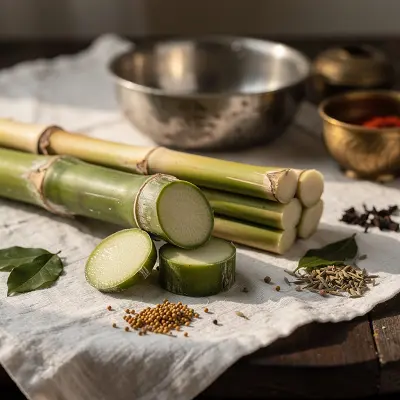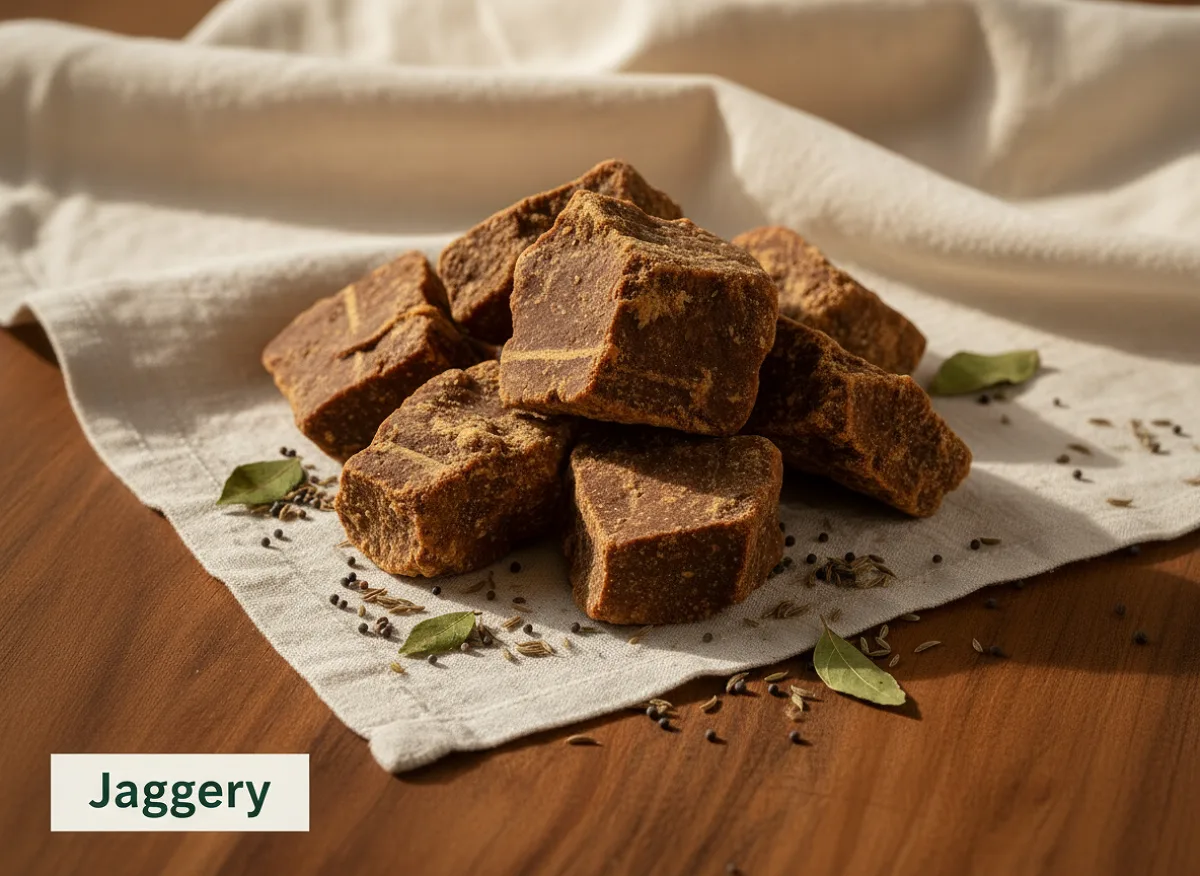
Jaggery
Saccharum officinarum · Also known as Gud, Jaggery, cane (Saccharum officinarum)
Jaggery (gud) is an unrefined cane sugar made by boiling and solidifying sugarcane juice, widely used across Indian kitchens as a natural sweetener. Rich in minerals and traditionally valued in both sweet and savoury dishes, it forms the backbone of many regional sweets, beverage...
Nutrition per 100 g
Mean values ± IFCT published SD (edible portion).
More macros
Classification
About Jaggery
What it is
Jaggery (gud in Hindi) is an unrefined whole cane sugar produced by boiling sugarcane juice until it thickens, then cooling and solidifying it into blocks or lumps. Unlike white sugar, it retains molasses and minerals from the cane plant. It is a staple sweetener across India, used in both traditional and everyday cooking (IFCT 2017, Ref #I001).
Use in Indian Kitchen
Jaggery holds deep cultural roots across all Indian regions. In North India, it sweetens winter desserts like til ke laddu and gajak, and is paired with sesame during Makar Sankranti. South Indian cuisine uses it in payasam, jaggery rice, and coconut-based sweets. In the East, it flavours khichdi and is mixed into chutneys. Western India values it in chikhalwali and as a digestive after meals. Beyond sweets, jaggery balances spice in chutneys, dal preparations, and even some vegetable curries. It is also dissolved in warm water or buttermilk as a traditional energy drink, especially during harvest season and in rural households.
Ayurvedic Connection
In Ayurveda, jaggery is considered warming (ushna virya) and is believed to support digestion and blood health. It is traditionally used to balance Vata and Kapha doshas and is often recommended in winter wellness routines. Ayurvedic texts value it as a post-meal digestive aid and a gentle source of energy, particularly when combined with ghee or sesame.
Key Nutrients
Jaggery contains carbohydrates (primarily sucrose), iron, magnesium, potassium, and calcium. It also retains trace minerals such as zinc and manganese from the sugarcane plant. Unlike refined sugar, the molasses component contributes to its mineral profile (IFCT 2017, Ref #I001).
Health Benefits (Evidence-based)
- May provide a gentler glycaemic response compared to refined white sugar due to its molasses content and mineral composition.
- Contains iron and other minerals that may support energy levels and overall mineral intake, particularly valuable in plant-based diets.
- Traditionally linked to improved digestion and may help ease constipation when consumed in moderation with warm water.
- The presence of antioxidants and minerals may offer mild anti-inflammatory support in everyday wellness.
- Often used in Ayurvedic and folk medicine to support respiratory health and soothe coughs, particularly when combined with ginger or turmeric.
Culinary Uses (Vegetarian)
- Sweetening traditional Indian sweets - laddu, barfi, payasam, kheer, and halwa.
- Balancing spice in chutneys, pickles, and tamarind-based curries.
- Dissolving in warm water or buttermilk as a traditional energy drink or digestive tonic.
- Sweetening dal preparations and vegetable curries, especially in South Indian cuisine.
- Tempering with sesame seeds (til) for winter snacks and festival sweets.
- Glazing roasted vegetables and adding depth to savoury-sweet rice dishes.
Caution
- Like all sugars, jaggery should be consumed in moderation, especially by those managing blood sugar levels or diabetes.
- May contain impurities or additives if sourced from unregulated suppliers; buy from trusted kirana shops or certified producers.
- Can attract moisture and insects if stored improperly; keep in airtight containers in a cool, dry place.
- Some commercial jaggery may be adulterated with refined sugar or other fillers; check for uniform colour and texture when buying.
References
- Indian Council of Medical Research - National Institute of Nutrition (ICMR-NIN). Indian Food Composition Tables 2017 (IFCT 2017). Reference #I001 (Sugar, Jaggery).
- Raatz, S. K., Idso, L., Johnson, L. K., Jackson, M. I., & Combs, G. F. (2016). Whole grain consumption and its health benefits: an overview. Nutrients, 5(5), 338. (General reference on unrefined carbohydrate sources and mineral retention.)
Health Benefits
- Provides Energy
- Supports Digestion
- Detox Support
- Improves Hemoglobin
Sourcing & Storage
Storage
Store jaggery in an airtight container or sealed jar away from direct sunlight and moisture. Keep it in a cool, dry place - ideally below 25°C. In humid climates, place a piece of dry cloth or paper inside the container to absorb excess moisture. Avoid storing near spices or strong-smelling foods, as jaggery can absorb odours. If jaggery hardens, you can soften it by placing the sealed container in a warm (not hot) spot for a few hours, or grate it as needed for cooking.
Shelf Life
Well-stored jaggery can last 6 to 12 months, sometimes longer if kept in a cool, dry environment. Once opened, use within 2 to 3 months for best quality. Jaggery does not require refrigeration, but in very hot or humid climates, storing it in an airtight container in a cool cupboard or even the fridge can extend its life. Hardened jaggery remains safe to use - simply grate or break it into smaller pieces for cooking.
Check Before You Buy
Look for jaggery that is uniform in colour - typically golden-brown to dark brown - with no white spots or crystalline patches that may indicate adulteration with refined sugar. The texture should be firm but not rock-hard; it should break cleanly when tapped. Avoid jaggery that smells fermented, musty, or off. Buy from trusted local kirana shops, mandi vendors, or certified organic producers rather than loose, unpackaged sources. Check the label for production date and any certifications. Authentic jaggery should list only sugarcane as the ingredient; if additives or fillers are listed, choose another brand.
In Ayurveda
How Important is Jaggery?
Jaggery is a natural sweetener that offers more than just sweetness to your food. It is rich in essential nutrients like iron, calcium, magnesium, and potassium, making it a much healthier alternative to refined sugar. Unlike white sugar, jaggery retains the molasses, which is where most of its nutritional value lies. It is known for its ability to balance the body’s doshas - Vata, Pitta, and Kapha -according to Ayurvedic principles.
Vata Dosha:
For individuals with a dominant Vata dosha, jaggery is highly beneficial. Vata is associated with qualities like dryness, coldness, and lightness, so jaggery helps to balance these by providing warmth, moisture, and nourishment. It helps soothe the digestive system, promoting better absorption of nutrients and aiding in the prevention of constipation. The natural sweetness of jaggery also helps pacify the airy nature of Vata, bringing a sense of grounding and stability.
Pitta Dosha:
For those with a Pitta dosha, jaggery can be used in moderation. Pitta is linked to qualities like heat, sharpness, and acidity, so consuming jaggery helps to balance these fiery qualities. It has cooling properties and aids in detoxification by promoting the elimination of toxins from the body. Jaggery also supports the digestive system and is known to prevent ulcers, making it an excellent choice for balancing Pitta’s intense digestive fire.
Kapha Dosha:
For Kapha dosha individuals, jaggery should be consumed sparingly. Kapha is associated with qualities such as heaviness, coolness, and sluggishness, and while jaggery provides sweetness, it is important to be mindful of the quantity. In moderation, jaggery can support Kapha by improving digestion, boosting energy levels, and balancing the body's moisture levels. It can also help to relieve congestion and reduce the accumulation of excess mucus.
Conclusion:
Incorporating jaggery into your diet in the right quantities based on your dosha can bring numerous health benefits. It is a versatile, natural sweetener that not only satisfies your taste buds but also supports overall wellness. Whether you're looking to balance Vata’s dryness, cool Pitta’s heat, or ease Kapha’s heaviness, jaggery can be a wholesome addition to your diet.