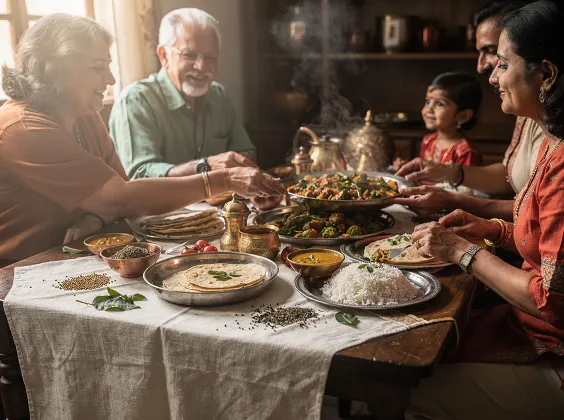
The Family Nutrition Problem: Feeding a Diabetic Grandparent, a Growing Teenager, and a Toddler from One Indian Kitchen
It's 1 PM on a Tuesday, and one woman is standing in front of her stove trying to solve a puzzle nobody trained her for. Her father-in-law needs low-sugar, low-salt food for his diabetes. Her fourteen-year-old needs enough protein and calories to keep up with school, sports, and a growth spurt that seems to restart every few months. Her two-year-old needs soft, mild, iron-rich food that won't upset a still-developing gut. One kitchen. One cook. Three completely different sets of needs, all expected to come together by lunchtime.
This is Indian family meal planning as it actually exists in millions of homes - not a tidy diagram of food groups, but a daily negotiation between competing biological needs, all happening in real time, with real ingredients, in real heat. Most nutrition tech built for India still imagines a single user logging a single meal. It rarely accounts for what we'd call multigenerational Indian nutrition - the everyday reality of feeding very different people from the same pot.
Why One-Size-Fits-All Meal Planning Fails Indian Families
Most nutrition apps are built around an individual. You log in, enter your age and weight, and get a plan built for you alone. That works reasonably well for someone living independently, eating on their own schedule, from their own pot. It breaks down completely in a typical Indian joint or extended household, where one kitchen routinely serves three or four generations under one roof, often from the same handful of dishes cooked once a day.
The mismatch shows up in small but constant frustrations that most families have simply learned to work around without naming the underlying problem:
- A diet app suggests a meal plan for the grandfather's diabetes, but it doesn't account for the fact that the same dal pot is feeding a toddler who needs it milder and a teenager who needs a bigger portion to fuel an afternoon of school and sport.
- A calorie tracker logs the teenager's lunch accurately, but has no concept of how that same roti, made slightly differently, should look on the grandparent's plate, or how much smaller a portion the toddler actually needs.
- Generic recipe apps assume everyone eats the same dish in the same way, ignoring that family diet India multiple conditions almost always means subtle, simultaneous variations of the same base meal - not three entirely separate kitchens running in parallel.
- Most apps also assume a single decision-maker logging a single plate, when in reality one person in the household - usually managing the cooking, the shopping, and the health needs of everyone else - is making three or four nutrition decisions before the food even reaches the table.
The real-world skill Indian home cooks have quietly mastered for generations - making one base meal flexible enough to suit everyone at the table - is exactly what most nutrition technology fails to model. It treats this daily juggling act as an edge case, when for a large share of Indian households, it's simply how every single meal works.
The Diabetic Grandparent: What Actually Needs to Change
Managing a diabetic grandparent Indian meal plan inside a shared kitchen isn't about cooking a separate dish. It's about understanding which parts of the existing meal need adjusting, and by how much.
- Carbohydrate portioning matters more than carbohydrate elimination - the same rice or roti, in a smaller, more consistent portion, paired with more fibre and protein, often works better than cutting it out entirely.
- Sodium awareness becomes important alongside sugar, since many elderly patients also manage blood pressure. ICMR's national dietary guidelines specifically flag restricted salt and sugar intake as priorities for managing non-communicable diseases like diabetes and hypertension, which together account for a large share of India's disease burden.
- Timing and consistency matter as much as content - eating at regular intervals helps avoid the blood sugar swings that come from skipped or delayed meals, something easy to overlook in a busy household.
- Cooking method adjustments, like reducing added ghee in the grandparent's portion while keeping it in the teenager's, let one base dish serve two very different needs without doubling the cooking.
Why "ICMR Family Nutrition" Guidance Matters Here
This is where ICMR family nutrition guidance becomes genuinely useful rather than abstract. ICMR's Recommended Dietary Allowances are built around Indian body composition, activity levels, and disease patterns - not generic global averages. For a household managing multiple conditions at once, having age- and condition-specific reference points grounded in Indian data, rather than borrowed Western standards, makes the difference between a meal plan that's theoretically correct and one that's practically usable in an Indian kitchen.
The Growing Teenager: Easy to Overlook, Hard to Get Wrong
Teenagers are often the easiest household member to overlook in family meal planning, simply because they don't have a diagnosed condition demanding attention. But growth itself is a nutritional event. A fourteen-year-old going through a growth spurt has meaningfully higher protein, iron, and calcium needs than either the grandparent or the toddler at the same table.
- Protein needs rise sharply during adolescent growth phases, making dal, paneer, eggs, or curd genuinely important additions rather than optional extras.
- Iron requirements increase too, particularly for teenage girls once menstruation begins - a detail that's easy to miss in a household focused on managing an existing diagnosis elsewhere at the table.
- Active teenagers, especially during India's hotter months, lose more fluid and electrolytes through sweat than the rest of the household, and often don't replace either adequately on their own.
The Toddler: Small Portions, Big Stakes
A toddler's plate looks nothing like the rest of the table's, and it shouldn't. Smaller stomachs, developing digestive systems, and a critical window for brain and physical development mean a toddler's meal needs to be calorie-dense in a small volume, softer in texture, and mild in spice - while still drawing from the same core ingredients cooking on the stove. Toddlers also can't make up for a missed nutrient at one meal the way an adult can; consistency across the day matters more at this age than it does for anyone else at the table.
This is usually solved instinctively by Indian home cooks: mashing a portion of dal before adding chilli, setting aside a milder piece of vegetable before the final tempering, or blending a portion of khichdi before it's spiced further for the rest of the family. Many households also hold back a small portion of ghee or a mashed banana to boost calorie density without increasing volume, since toddlers fill up quickly but still need concentrated energy and nutrients.
The skill is real, and most parents and grandparents carry it without ever writing it down. What's missing is a system that can model it consistently - accounting for which nutrients matter most at this age, flagging when a modified portion might be falling short on iron or protein, and doing it without turning toddler feeding into a separate research project every single day.
One Kitchen, Multiple Diets: What Makes This Solvable
The good news is that one kitchen multiple diets India is a solvable problem - it doesn't require three separate cooking processes. It requires structuring meals correctly:
- Start from a shared base - a single dal, vegetable, or grain dish that's nutritionally sound for everyone before any household-specific adjustment is applied.
- Apply targeted variations - adjust fat, spice, portion size, and texture for each person's specific needs, rather than cooking entirely separate dishes.
- Layer in seasonal and climate adjustments - during India's hotter months, heat raises everyone's fluid and electrolyte needs, but not equally; an active teenager and an elderly grandparent need different hydration strategies even on the same hot day.
- Track what matters for each person - sodium for the grandparent, protein and iron for the teenager, texture and portion size for the toddler - without needing to track everything for everyone.
This is precisely the kind of problem personalized nutrition technology should be solving, and it's exactly where most consumer-facing AI meal planner tools fall short - they personalize for one user profile at a time, not for a household cooking from one shared pot.
How
AamoAI™
Approaches ThisThis is the gap we built AamoAI™
You can read more about how our approach works on our about page, or explore the platform on our homepage.
Conclusion: The Kitchen Doesn't Need to Become Three Kitchens
Feeding a diabetic grandparent, a growing teenager, and a toddler from one stove isn't a failure of planning - it's the everyday reality of Indian family life, and it deserves nutrition technology that understands it as such. The answer isn't more separate apps, more separate diets, or more separate cooking. It's a system smart enough to see one meal and three sets of needs at the same time, the way a good home cook already does.
If you're building a dietician software tool, a family wellness platform, or anything that needs to model real Indian households rather than isolated individuals, AamoAI™